Poetry

The Breeze & The Black Door: Poems by Mack W. Mani [OUT NOW]

I’m pleased to announce the release of my debut collection of poetry, available now via Amazon. Most of these pieces have been published separately in literary magazines over the last ten years, and it’s my pleasure to present them alongside several previously unpublished poems. Complimentary digital copies are available upon request for the purposes of review (see below). Here’s a little more information on the collection:

A cold breeze on a hot summer day.

Hot breath on Halloween night.

Distant stars beckon and blink out of existence.

From within the dusty halls of an old mansion, the black door is calling, waiting to be opened…

In this debut collection from award-winning poet Mack W. Mani, haunted houses, nuclear reactors, dystopian cityscapes, and unincorporated territories are twisted and reflected into prophetic visions of the past, present, and future. By turns startling and profound, these poems find new connections and meanings in the genres of horror, myth, and science-fiction. Purchase a digital or paperback copy via Amazon, with other retail options forthcoming.

If you would like to read The Breeze & The Black Door for free, with no obligation other than providing an honest review, please reach out to the author via email at MWMani@gmail.com with your name and preferred format of document (epub, pdf, docx, etc). Reviews can then be left on the website of your choice, though Goodreads, Amazon, or your personal website are preferred. If you have any questions or concerns, please contact the above address.

Standard
Poetry

The Breeze & The Black Door

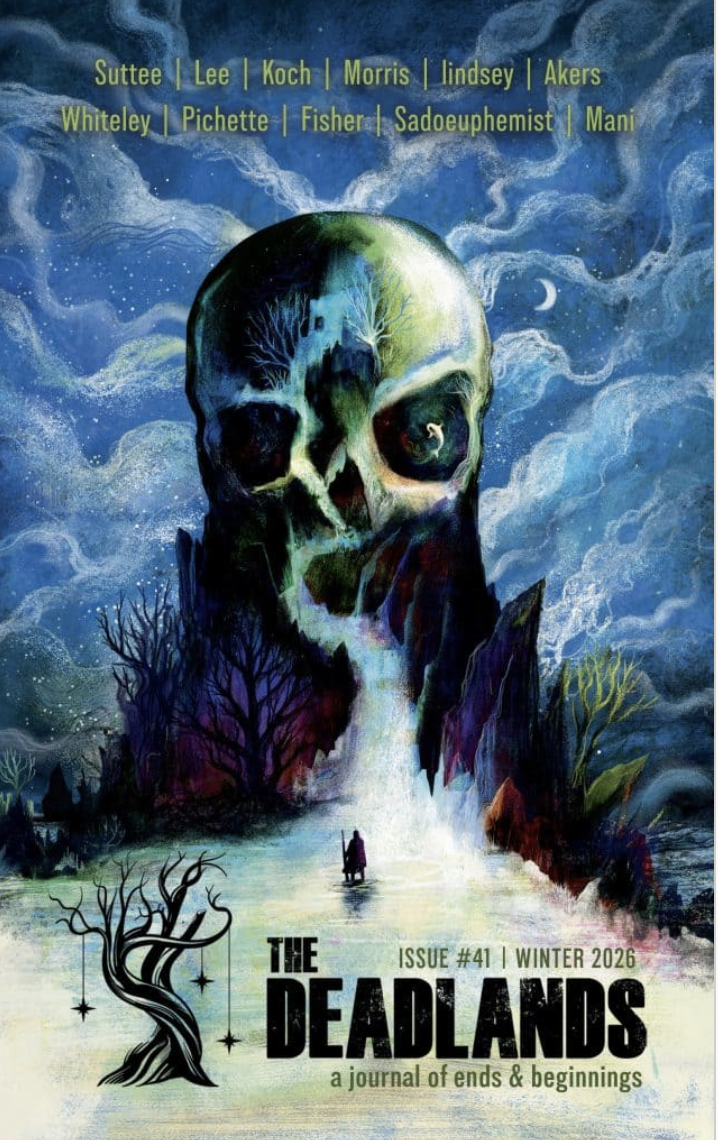
Have you ever lost someone to themselves? Watched slowly as they slipped away from you, despite everything you’d been through? My latest poem in Deadlands Issue #41 is about the ones we love and how they can change right before our eyes, day by day, until all that is left of them is a memory. Read the full poem here along with the rest of the issue for FREE. But here’s an excerpt to get you started:

I heard some movement at my front door
but it was just a storm.

Drank my beer over the sink
so I didn’t stain my shirt anymore.

Fixed the leak
and found a place on the floor.

Wife’s been leaving the back door unlocked.

Not every night,
but enough to raise the question.

She bought some paint and a brush home
from Benny’s Department Store.

Had me paint that old back door
as black as a raven.

So I stripped myself to the waist
to feel the Halloween breeze
and did as she pleased.

I heard her unlock it
last night in her sleep.

Standard
Poetry

Champagne Remnants in The Non-Binary Review

I have a new sci-fi poem out now in The Non-Binary Review issue #40. The theme was epiphany and I had a great time writing this one. Read an excerpt below and get your copy here!

Champagne Remnants

Shipwrecked on Blackstone Delta
S.O.S.

Her hometown became a dream,
a glittery story filled with secrets,
caricatures and blue neon hues;
Twin Peaks by way of John Hughes.

Small town gods,
brief and beautiful
finite and divine:
mayors and mayor’s sons
garage bands and single moms
shiny linoleum dulling all summer long,
cigarette smoking schoolgirl dreams
descending every night to rocky shores
of methane swamps where it is said
2001 is a nursery rhyme.

Standard
Short Fiction

Dreams of the Ghost House in Black Sheep Magazine

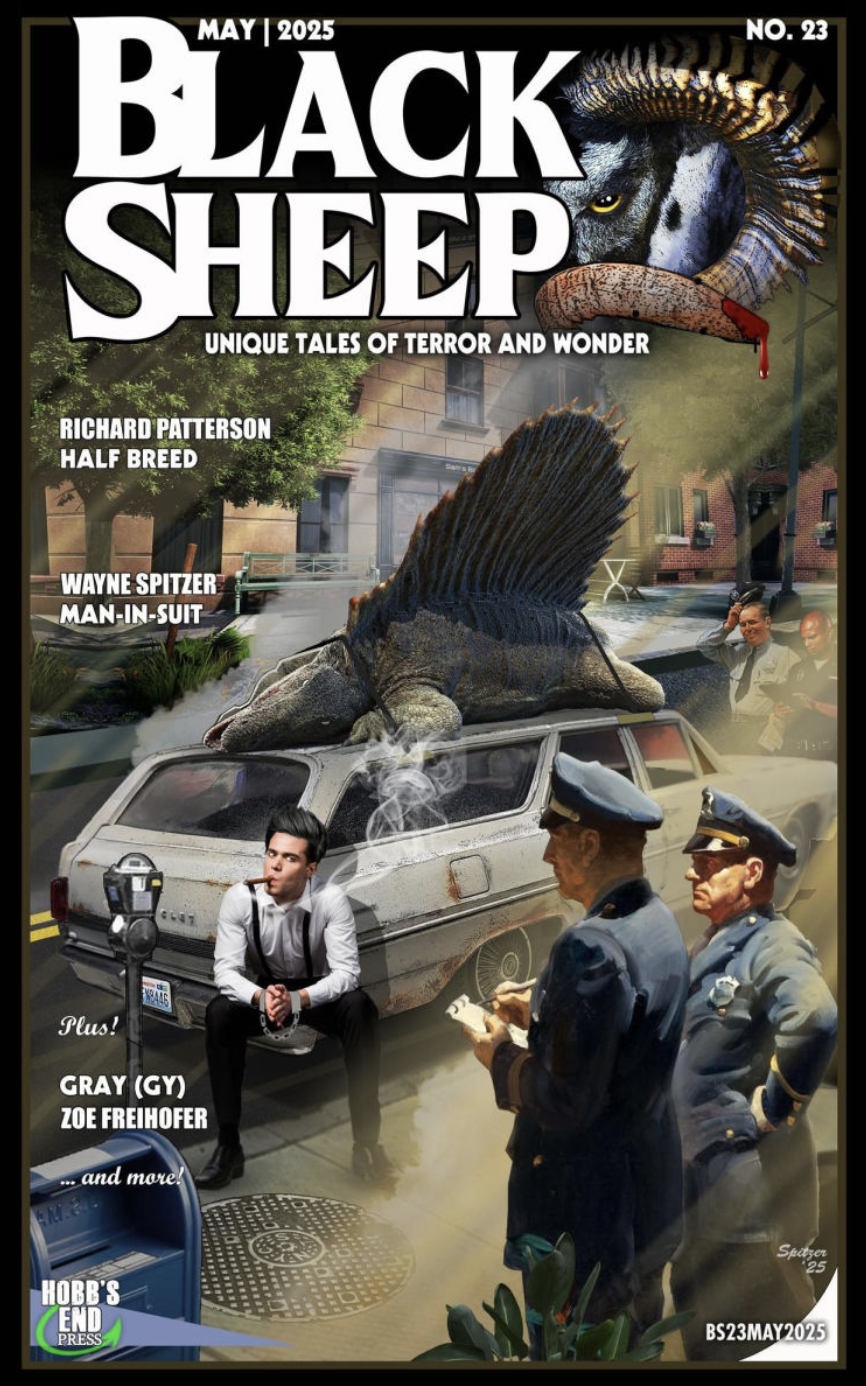
My latest short story is in the new issue of Black Sheep, on sale now! Read an excerpt below and pick up your copy of the magazine (digital or physical) here.


There were only two homes on Lost Loon Lake, the Arthur’s sleek modern summer house and a gimcrack mansion directly across the water, half shrouded in pine and time. Its cracked and peeling Georgian columns and rococo balustrades spoke to a bygone era of old money, when for the ultra-wealthy bigger was always better. That place had two names and the first was Autumnhall, enormous and empty.

The older people of the nearby town (if twenty miles can be said to be near) rarely spoke of it, and even then, only to comment on something else. Brodie had heard his mother or his aunt or the women at the diner saying things like, “Don’t run around with Charlie Mayse, he takes girls past Autumnhall and dumps them come spring.” Or “Lord, I tell you she can’t keep a house! Her place puts Autumhall to shame.”

They used it like a ward, as if to diminish it in their minds. The younger people in town were nowhere near as reserved and it seemed like there was always some new wrinkle being added to the legend of The Ghost House on October playgrounds or whispered on late and wild drunken teenage nights.

Standard
Short Fiction

The Whiteout Murders

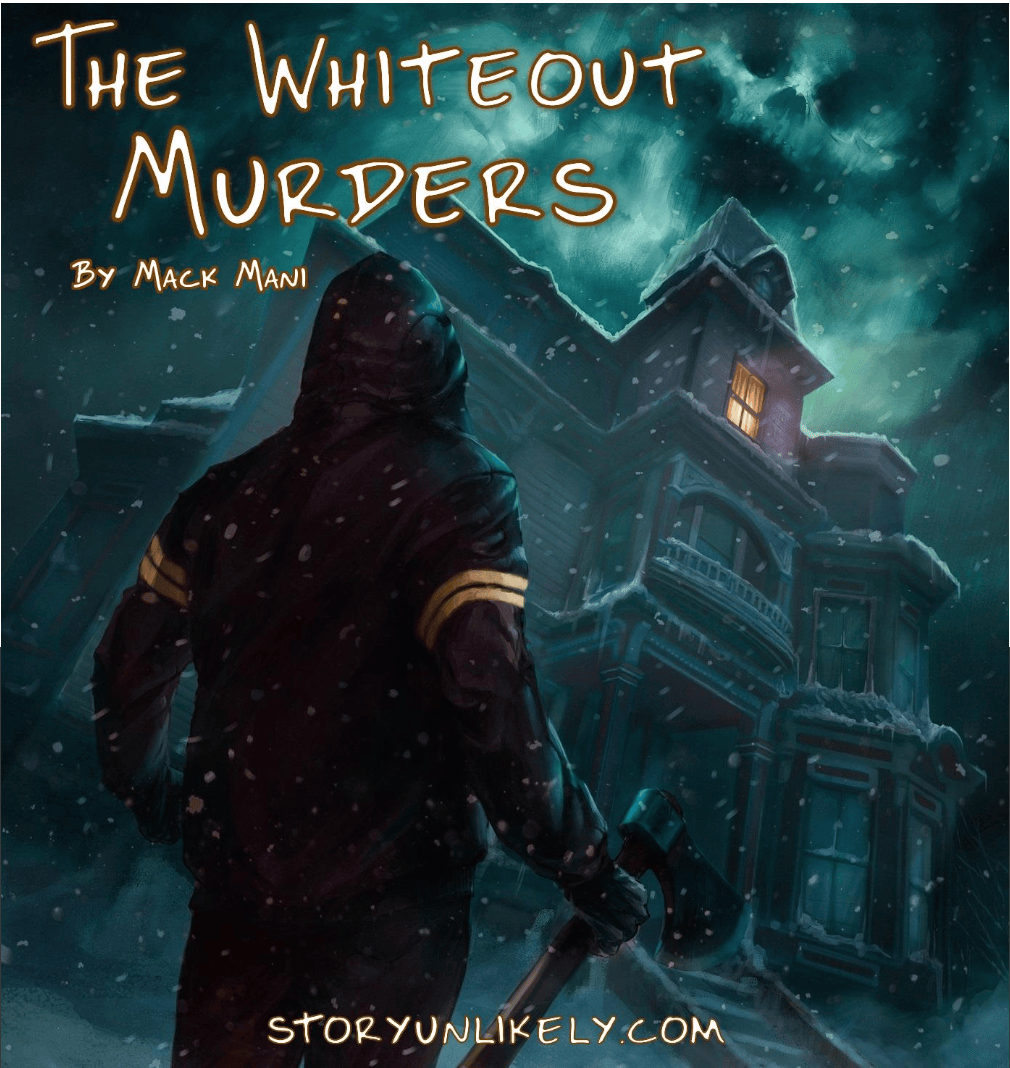
My latest horror short story titled “The Whiteout Murders” is up over at Story Unlikely, below is an excerpt. You can read more by following the link and subscribe to read the whole thing!

The next murders would occur mere hours later in a similar house, in a similar cul-de-sac, just a few streets over from the first. Around 2:00 a.m. the blizzard conditions worsened. Through the sleet and snow, the houses would have looked almost identical. Indeed, they had been manufactured by the same company in the early 1950s. Galway & Hobbes was one of the first to capitalize on the mass production of “cookie cutter” homes in the area. The Pascal residence was even painted the same hue as the Harrisons’—an off-color teal. The only difference that fateful night was that, unlike the Harrisons’ house, the entire Pascal family, Miles (41), Taylor (39), Marco (8), and Gabby (3) were at home, peacefully sleeping while a near whiteout storm raged just outside the warmth and safety of their abode.         

What did The Mangler think as he stalked the Palace Green Neighborhood’s backyards? He had already taken one life that night and gotten away scot-free. It would be another six days before the Harrison family returned from Florida to find what was left of their housekeeper strewn up and down the stairs. Art Harrison would later recall that had the weather been any clearer, their flight would have departed as scheduled and they would have arrived home almost twelve hours before the killer entered the house. If we continue to follow the theories of Sheriff Hutchins, The Mangler would have been anticipating their arrival. For him, the killing of Juana Herrera had been an act of necessity but after he looked at what he had done, seen the way he had spread her intestines out along the banister, the way her half-lidded, lifeless eyes stared up at the unlit Christmas tree (still up two weeks after New Year’s) he felt unsatisfied. He knew that his unholy urges would not be satisfied by the offhand murder and mutilation of a cleaning woman.         

He hungered for innocence.     

The last three sentences of the chapter had been sloppily underlined with a blue pen, and the word NO was scribbled in all caps in the faded yellow margin of the page. The book was titled The Whiteout Murders: An Analysis of the Most Disturbing Unsolved Homicides in American History by Damien Magalhäes & Harper Kinnaman. Noel had bought it partly because of its lurid cover: a hulking figure in a bulky winter coat, seen from behind. He stands in front of a row of perfect houses, shrouded in a snowstorm. From his right hand dangles a long-handled axe, dripping blood onto the ice below. As a screenwriter, it was the kind of imagery that Noel always tried (and often failed) to inject into his scripts. But the larger factor that drew him in was the smell. The smell of old paperbacks, the kind mass-produced in the 1970s, held a musky nostalgia for him, conjuring images of his grandfather’s little attic library stuffed with hundreds of old westerns and spy novels. Even the quote at the beginning of the volume seemed to echo this:

Nostalgia cannot exist at a single point in time.”- Edwin Poe (The Innocent Dead)
Standard
News, Short Fiction

OVERALL WINNER: Mack W. Mani “The Dweller in the Smoke”

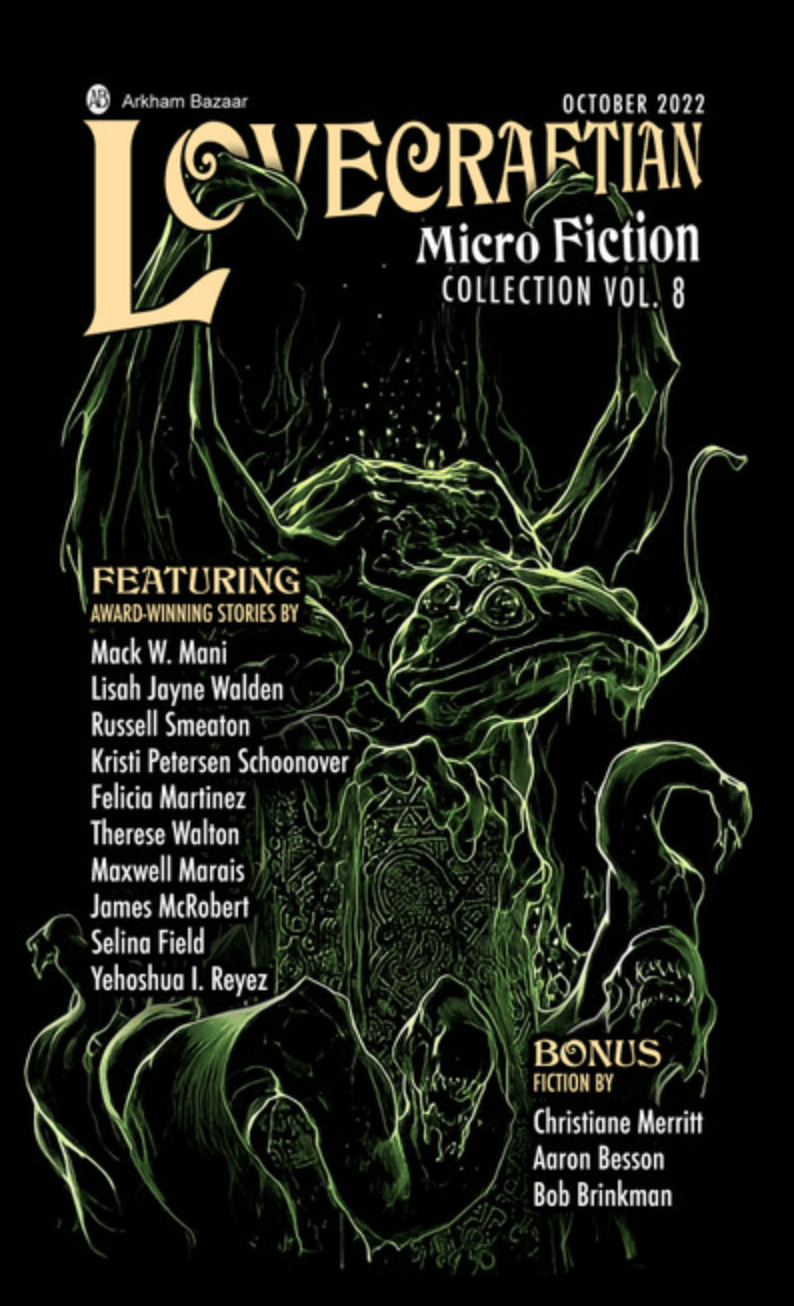
Last fall I was proud to accept the award for best micro-fiction story from the H.P. Lovecraft Film Festival. Here is a link to the announcement and a list of the other winners:

https://hplfilmfestival.com/hplfilmfestival-portland-or/news/2022-award-winners-0

And here is a link to where you can purchase a physical copy of the collection including my winning entry:

https://arkhambazaar.com/books/lovecraftian-microfiction-2022-tales-from-the-tainted-inkwell-collection/

Standard
Poetry

The Grave Robber’s Confession by Mack W. Mani

I’ve seen Will ‘o Wisps
and St. Elmo’s Fire,
mostly them in the Southlands
graveyards near bayous or swamps.

I once saw an entombed woman 
come back to life 
three days after her death,
I had just slipped the ring 
off her finger pale and bony,
when she gasped and rose with a cry.

One summer I lived 
in the catacombs beneath Paris
and for nigh on a month
never once saw the light of the sun,
only pale torchlight 
cast across fields of bones,
wooden chests rotted to their hinges.

I have walked the hall of ashes
and seen the rotting face 
of John the Baptist.

Once in Afghanistan, 
I even spied a ghoul
prowling the trenches near dawn 
picking the corpses 
of both sides equally.

These are my qualifications,
such as they are;
few know as much about death
and the places of the dead 
as grave robber, 
so believe me when I tell you,
there is nothing beyond the grave,
but me.

No voices 
or tunnel of light
just darkness, dust, 
and these two dirty hands,
trying to make a living.

Art:

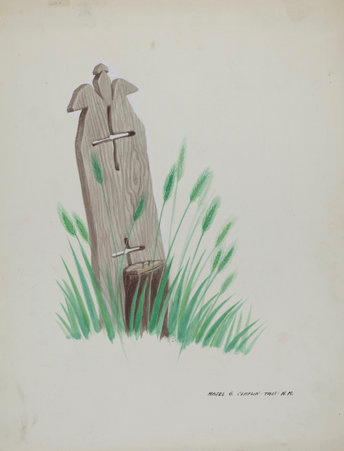
[Wooden Grave by Marker Majel G. Claflin c. 1937]
Standard
Poetry

Posthumous

I kept your book
in the garden
where you’d left it
and watched day by day,
as the elements took it over,
sun bleaching the cover
rain swelling its pages.

From the right angle,
I could just make out
your hand drawn notes,
splayed across a corner of text,
the dog-eared page where
you had stopped reading
that sunny afternoon.

In time,
it settled into the loam
and there beneath the roses
framed and shaded in
hemlock and holly,
the book began to take root.

Before long
it stood as tall
as a sunflower,
sentences folded
into leaves,
spine extending
as a stalk.

And at the peak,
new pages began to form
as petals, stamen, pistol
gently folded origami
words not written when
you read the book.

Abstract and wondrous
prose and poems
from beyond the grave,
death having evolved your speech.

Fragments of memoir,
experience and tragedy
the travelogue of a dream
a journey into the surreal.

…such gifts they make of life here…
…blinding sun fractals bent at odd angles…
…Galore and Gore and Grammar…
…the pretense of time, alive and unending…
…my love my love my love…
…do not seek me here, for I am in the earth…

The thing lasted
almost a year
before succumbing,
despite my best efforts,
to the eternal,
withering, bent, and grey
I found it dead
on New Year’s Day.

Still,
I have the transcripts
those I could discern,
interred under glass
in a brightly lit corner
where sometimes
I simply sit and watch
and pretend that I can still
hear you out the window
in the garden below,
living, breathing,
and turning the pages.

Standard
Essay

8 Tips For New/Unpublished Writers

1. Learn to write stories of different lengths/mediums.

Don’t be tied down to every idea as a novel or a screenplay. Some ideas simply work better as flash fiction or as a poem. If you’re not diversifying your output, then you are limiting the impact of your stories.

2. Submit to the right magazines (at the right time).

Take the time to compile a list of magazines and what types of stories they publish. Read what they publish. You are wasting your time and the time of the editor if you are unfamiliar with what the magazine wants.

Make note of their submission periods so you can stay on top who is accepting what types of stories.

Always check to see when the latest issue or post went online, there are lots of defunct magazines that still say they are “open for submissions”.

3. Submit regularly.

Give yourself regular deadlines to have work completed and submitted for either publication or contests. In the end, if you aren’t satisfied with what you’ve done, you don’t have to send it in, but it gives you a goal and a date to complete your project by.

(Don’t pay to enter or for consideration unless you are extremely confident in your work)

4. Do your cover letter right.

Use the editor’s name, if you can find it.

Don’t use a form letter for submissions, even if the magazine uses one for rejections.

Keep your cover letter brief, don’t describe your work, just who you are and that you thought it would be a good fit for their magazine.

Keep your bio professional, it’s okay to express yourself, but don’t try to make a lot of jokes or seem quirky, it comes off as desperate.

Don’t list 1,000 credits, just your most recent/prestigious publications. If you have no credits, keep it simple: Lucy Gordon is a French-Canadian Poet. She currently lives in Melbourne, Australia with her husband Thomas and their cat Judy. 

5. Don’t talk about writing, write.

It has been scientifically proven that talking about projects before they are completed gives one just enough satisfaction to feel like they do not need to complete the task. It’s better to share a finished product than an initial idea. Outside input too early in the creative process can muddle your vision and inhibit you from making something that’s truly your own.

6. Don’t be afraid to branch out.

Pursue your ridiculous ideas! 

In Wonderbook Jeff Vandermeer talks a lot about how important the imagination is in the writing process and emphasizes the importance of “creative play” or simply letting your mind go where it will. Indulge your fantasies and daydreams (and nightdreams for that matter) you never know what seemingly absurd idea will lead you to an amazing, original story.

7. Write everything down.

Make list of your ideas, interesting names you hear, locations, moods, scenes, if something in your daily life strikes you, then make a note of it because you will forget. 

Be organized, know where everything is. Don’t delete what you cut, set it aside for later use. Many times I’ve been inspired by seeing the scraps of two poems next to each other in my “cut document”.

8. Know the rules, so you can break them.

You’re going to do what you want anyway, but it helps to know what you’re pissing on and what you’re praising. Even if you want to write free form, non-rhyming poetry, it’s still helpful to learn about meter. If you never learn proper grammar, all your characters will sound casual and uniform.


Standard